The amount of time to rescue these objects can range from a few hours to a few weeks, and the actual process is very simple: “We just climb up there and chip away,” Grannen says. He and his employees salvage pieces from 50-75 buildings each year, and it's never an easy project. He shows me the grating from an elevator from the Granada Theater – which was torn down in 1990 after standing in Rogers Park for more than 60 years – while explaining the perils of working around with a wrecking crew . “We work before, during, and after they're done,” he says. “They almost got us with the [wrecking] ball while we worked in the building. They don't care at all.”
The majority of the buildings on which Grannen works are in the Chicago area, though his network of contacts extends all over the country and into Europe. Whenever a building with any sort of historical significance is slated for demolition, Grannen is ready to travel, no matter the distance. While the majority of the buildings are in Chicago, the majority of his sales are outside, usually on either coast. “There just isn't the same appreciation here,” Grannen says.
Still, the question remains: Is this preservation? To some extent, the answer to such a question is going be based on the individual who's doing the answering. To think only in terms of simple preservation – the restoration of only a building's defects, without changing any vital parts, keeping the structure free-standing and not threatening its surroundings – is probably too narrow-minded. The world that we inhabit, quite simply, is out of space. The cities in which we live are already sprawling. Leaving every building with any aesthetic value standing would only result in endless, empty cities, with preserved buildings impeding progress. Perhaps the only way to preserve as much of the past as possible is to follow the lead of companies like Architectural Artifacts, doling out remnants of the past to anyone who might appreciate them.
There certainly isn't enough museum space to hold everything in Grannen's collection – his renovated sales floor will eventually span over 80,000 square feet. So the question ultimately becomes one inseparable from the definition of art, one wildly debated for centuries, and one not likely to be answered here. Is it productive in any way for art and architecture to be gracing the garden of a million-dollar home? Not for some, perhaps, but for others, the simple fact that the memorable aspects of these buildings are viewed somewhere, even if only by a select few, does more to maintain the legacy than their outright destruction and disposal.
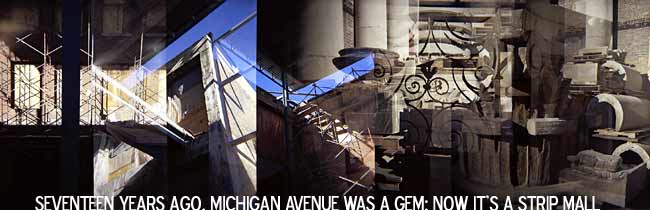
While Chicago is known for its outstanding architecture, it very well may be that these achievements are slowly being destroyed, by wrecking ball and by the artless new construction. “When I first moved here, seventeen years ago, Michigan Avenue was a gem; now it's a strip mall,” Grannen says, without the smile on his face that one might hope to see. “Very little modern commercial architecture will become historic architecture. The buildings are strictly dollar-driven.”
|