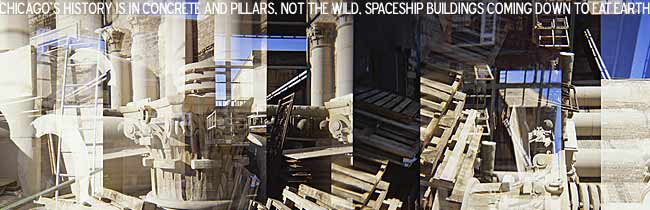
In his attempt to preserve the architecture that gave Chicago its reputation, Grannen is currently constructing a 15,000-square foot museum of pieces from Chicago buildings, with plans to open in the fall of 2004. Featuring everything from Frank Lloyd Wright to Louis Sullivan, Grannen hopes the museum will give a glimpse of the beauty of Chicago's past. None of the pieces in the museum will be available for sale, as all are from Grannen's personal collection. His attempts to preserve the rich history of architecture extend beyond his museum to his daily activities. While some customers hope to buy pieces from Grannen and then drastically change the piece's character, Grannen won't allow it, if he's able to prevent it.
“If some couple tells me that they want to paint a gorgeous mantelpiece white, I'll suggest that they don't,” he says. “If they say ‘that's what we're going to do,' I won't sell it to them. I just can't do it.” When asked about the customers who completely reconfigure pieces, such as those who might destroy a pillar to make the base for a coffee table, Grannen shakes his head in disapproval, but acknowledges the thought behind the act. “If they have an appreciation, and it's done right, it can provide a link to the past,” he says. “But it's not often done right.”
As for the newer projects that have graced – or will grace – the Chicago skyline, he remains mostly tight-lipped. Of the horrendous new Soldier Field, Grannen acknowledges the effort to do something new, but criticizes the results. “It looks like nothing else around it,” he says. “Chicago's history is in concrete and pillars, not the wild, spaceship buildings coming down to eat Earth.” Of the Frank Gehry-designed Millennium Park, Grannen again plays the role of the architectural purist, citing the jarring contrast between new materials, style and Chicago's history, but he'd rather hold judgment until it's completed. New construction is not all bad, however: He does give a great deal of credit to Chicago Mayor Richard Daley for his efforts in restoring the beauty of a number of Chicago's public high schools.
It very well may be that those who expect to see their favorite buildings and homes preserved will have to either face the reality that their wishes will not be fulfilled, or must learn to adapt to a new style of preservation. Certainly everyone would like to see the architectural history of the city and the demands of progress meld in such a way that all are appeased. If this is to happen, the roles of urban archeologists, like Grannen, may have to be enhanced. The pool of buildings that could achieve landmark status is slowly dwindling as the city's demands begin to outweigh the sentimentality of its residents. The difficulty will be in trying to find a balance between the possibilities. I won't suggest Grannen or others like him have solved the problem – or even that everyone will agree with this method of preservation – but I would use it as an example of an effort to bridge the gap between the architectural highlights of the past and the demands of modern life. Gorgeous buildings will continue to be torn down, and some atrocious ones will be erected – hello, Mr. Trump! – but for all those who can't get over the demise of their favorite buildings, they can now, at least, own a piece of them.
Images of Architectual Artifacts courtesy Doug Fogelson, whose exhibition "Intersections" is now showing at the Kraft Lieberman Gallery. For more information, visit www.dougfogelson.com.
|