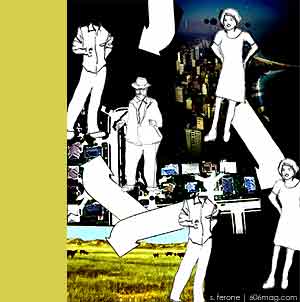
We work in cycles. Like the immigrants who idealized the American city as a wilderness of economic opportunity and self-realization, a new generation, born during the exodus into the suburbs and reared on the family values that gave rise to the suburban sprawl, again confronts the city as a contemporary frontier. This untamed area is ripe with sensory bombardment that mimics our national fetish with opportunistic bohemianism, as we are a nation that views relocation as progress. The same decaying city that drove our parents out into the suburbs is, to our generation, completely unfamiliar, and thus suitable for exploration.
Every once in a while, I'll go home and run into a kid I went to grade school with that still lives in my old neighborhood. These kids sometimes hang out in the bars and bowling alleys where we grew up. They go to the same dentist. They have a dentist. We, the newfound city kids, haven't had our teeth cleaned since high school. We're too busy drinking cheap independent-organic-fair-trade coffee and looking for parking spots on our one-way streets. We are waiters and receptionists and painters, and sometimes we never sleep. The point is we are not our parents. The point is we are pursuing the next generational American dream. But we won't label it as “American,” because we are, in truth, saving up our money at the restaurant or office or coffee shop to move to some small eastern European city with better coffee, where we will eventually die like Kafka. But some of us still get money from Mom, or we spout theory about politics based upon the liberal arts education Dad paid for. But we are happy to pay the 8.75 percent sales tax, happy to eat lots of beans and rice, happy to take public transportation everywhere. Some of us think the “ghetto factor” of public transportation is “charming.” We're living in the city anyway, and that's a start.
With this in mind, the Pursuit of Happiness becomes very distinctly about domesticating new territory. When that phrase was plopped, last-minute, into the Declaration of Independence to fill the space where “property” used to be, the pursuit of happiness was a phrase that had more to do with a community sensibility than it had to do with self-interest. In 1776, “pursuit” implied action for the “common good.” Now the phrase has become synonymous with personal satisfaction and a well-rounded social or professional life. But with the way we chase happiness in and out of the city, the phrase might have read, “the pursuit of finding the right place to live,” or maybe “property” would have worked all right after all.
In his 1969 interview series, “Division Street: America,” Studs Terkel speaks with immigrants from other parts of America and across national borders about the city and their place in it. In one interview, Native American Benny Bearskin describes “getting urbanized” as tantamount to learning to live in the wild: “You have to learn the ropes … just like a person moving out from a prairie country and into the woods. There are certain dangers in such a transition and it's the same way in a city.”
Learning to negotiate the urban or the suburban is a contemporary attempt to discover uncharted space in a country that has been thoroughly mapped out for over a century. My roommate works on Division Street. Two mornings a week she opens a café, and walks down Division at 5 a.m. to get the scones ready. She keeps her stride fast and her head tucked toward the sidewalk; her keys are laced between her fingers. She once was attacked by a wild animal (a dog on a leash) that took a bite out of her down jacket. She tells me she never feels so much a part of a city then when she's forging her way down Division Street to make ends meet. The city street then becomes an urban frontier in which opportunity can be measured in relative danger and sacrifice. Our acclamation to unfamiliar conditions measures our adaptability, success, and by proxy, our degree of contentment. It is, of course, another idealized survival fantasy, but it works.
|