 |
03. Green churches dedicated in 1882: symbol of life or conduit to Satan? Rating: 3.7
I've reviewed church-intersections before , but very few spiritual edifices can match the grandeur of stonework displayed by the Greenstone United Methodist Church . With a congregation led by Bille J. Westmoreland and walls of – as the name demonstrates – green stone, who could be led astray by the temptations of the Wicked One? Let's review our symbolism via quick Google searches : green can be a neutral representation of plant life around us. It can also be a sign of vitality and pleasure in heraldry. And, let's not forget that in the Middle Ages, green was a direct association with the devil, as the Prince of Lies hunted souls in a green frock. Like any good historian, we can be as revisionist as we please , so let's say – for argument's sake – that the Greenstone Church is the permanence (here's the symbolism of stone) of life's ever-present cycle of rebirth, or the continuance of sin in the realm of mortals or even the vigor of the human spirit all made manifest in a house of worship.
Or you could call it all schlock, and say the stone came from a quarry in Pennsylvania and looks cool. I'm espousing this one, but to each his own, as the saying goes.
In a fine ‘80s film, Dan Aykroyd tells a group of prisoners, “the architect must have been a certified genius or a certified wacko.” Bonus points go to anyone who can name the movie, but I don't think I've ever found a more perfect use for the quote. The wood around the stained-glass windows is yellow. Dragons are carved in relief all over the place. The place is, like a girl who wants to make you sandwiches all afternoon , interesting and unique. Were I a Methodist living in close proximity to the church – of which neither is true – I would most certainly spend my worshipping hours in the green confines of Greenstone.
|

|
04. Attached-row homes spanning entire blocks: being different is bad. Rating: 4.5
Our intrepid guide to the Pullman area, my angel Ms. Moore, gave me a pamphlet that told me the ever-useful information that “intricate brickwork and gingerbread can be found throughout the Pullman Historic Landmark District.” Naturally. “Gingerbread,” once I looked it up, of course, refers to intricate saw cuts in a building's decorative latticework. And all this time I thought it was a baked holiday delight . But since the row homes are one of the district's distinct selling points, they were worth a look.
The thing about row homes is their cookie-cutter similarity. They are, quite literally, all the same. None of this ugly suburban sprawl, where the nasty blue siding house is jutted up against the regal brownstone or the dilapidated shack shares an alley with the red-brick white-picket-fence job. No, these are row after row of sameness. Makes me think of A Wrinkle In Time , where all the kids were jumping rope on the same beat and all the mothers poked their heads out the front door simultaneously. Except I don't recall seeing very many kids, so I guess the metaphor only works so far.
I have to celebrate the one house on St. Lawrence Avenue , however, that proudly displayed its individuality by shamlessly tacky-ifying its front yard with the addition of quite a few plastic pink flamingos . Now these are residents with some flair, with some panache. But such a decorating scheme has its downfalls, since the residents are most likely the reasons for town hall meetings where someone stands up, screaming, “You can't handle the truth!” or something similar, inciting mobs to riot, ensuring the imminent destruction of the pink flamingos, the source of all the ire in the first place. It's the great wheel of karma.
|
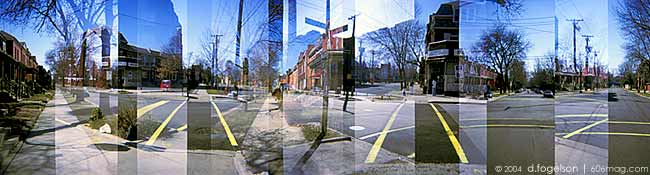
Some images courtesy Doug Fogelson, whose exhibition “Intersections” is opening April 30 at the Kraft Lieberman Gallery. For more information, visit www.dougfogelson.com . |




