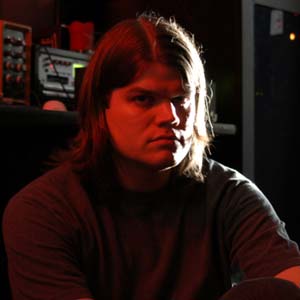
When I speak to him on the telephone, I give the street address of the café where I'd like to meet. I am trying to pick somewhere discreet, dark during daylight, somewhere where a tape recorder will not provoke eavesdropping attention. When he walks in the whole staff greets him; they already know what kind of coffee he likes. “Hey, John,” says the girl behind the counter. I offer to pay for his drink, but the waitress assures me he won't be charged. His coffee is not on the house because he is John Hughes III, founder of Hefty Records. His coffee is not on the house because he happens to be the son of a famous 80's teenage cult-film director. His coffee is on the house because he's a regular. “I somehow always end up here,” he admits as he takes his seat.
John Hughes founded the independent record label Hefty in 1995, under which his own electronic music appears. He has helped local and distant bands get started under his musical guidance, he has written movie soundtracks and he has organized collaborative releases between artists. He is also a self-proclaimed “studio-hermit,” which is quite a phrase to be coming from the mouth of someone who in the first five minutes of being seated seems to be a class-A mingler, a sweet-talking latte negotiator .
Since his 1998 debut album, “Confidence in Duber,” Hughes' music has appeared under the alias Slicker. When he first started Hefty, Hughes was producing the music of his band, Bill Ding. Slicker's style diverges from Bill Ding, borrowing the throaty vocals characteristic of his early work, and fusing them with gritty electronic beats. Hughes has put out two full-length albums as Slicker, as well as an album of remixes and a few collaborative releases; his third full-length album has just finished production.
When both of our coffees are set on the table facing each other, my coffee and his coffee, it's time to begin. I pull the tape recorder from my pocket and place it one the table between the two of them, our friends, the coffee, hoping it will blend in up there with the sugar packets and the salt. But recoding devices generally don't blend in with condiments, and today is no exception. The conversation dies. I may as well have as nonchalantly placed an alien baby up there and expected it to promote casual dialogue.
We took at the tape recorder. We look at each other.
“Aw, now I'm going to freeze up,” he says.
“Really?” I ask, moved that I'm not the only one with a sensitivity to having my words played back to me at a later date.
“No, I'm used to it.” He smiles.
He smiles a cat's smile, the type of cat that has no qualms about knocking over your beverage after beguiling you into thinking you two really had some kind of cosmic cat-human connection.
“I am speaking with John Hughes III,” I say into the tape recorder.
I quickly center the recorder between us, as if this statement might be a point of contention.
Which it's not.
I ask him how Hefty got started.
“As an artist, I've always wanted to be involved in the way a record is marketed,” he says of Hefty's conception, “I didn't want to be embarrassed by anyone else's decisions. I guess it has something to do with wanting control over every little aspect. When you're working on a record in the studio, so much attention goes into detail that it's weird to turn it over when you're done. I like being involved in every step, and I think that artists appreciate a label that's run by an artist.”
Hefty Records began, more or less, after Hughes less-than-profitable college experience, as a way to get his own music out. He spent a year as a telecommunications major at the University of Ohio in Athens, OH, before coming back to Chicago to launch Hefty Records. Since 1995, Hefty has picked up enough speed for Hughes to take other artists onto his label, although it initially was an outlet for him to take an active role in his own music's production. These days, Hughes is enthusiastic about collaborating with artists Joshua Eustis and Charles Cooper of Telefon Tel Aviv, whose forthcoming record has recently finished production. Originally from New Orleans, Telefon Tel Aviv sent their demo to Hughes and have since relocated to Chicago as Hefty has taken them onto the label.
Hughes explains what he looks for when screening the quantity of music Hefty is sent. “When I listen to demos I try to scrape away everything and see what's left once you take away all the programming and effects and trickery. [Telefon] originally caught my attention because they Fed-Exed it to me. No one had ever Fed-Exed me a demo, which I thought was funny. It got me to rip it open right away. I listened to it and was completely blown away. I just look for good songwriters.”
(go to page 2)