“I was in Karrada yesterday- a popular area in central Baghdad . It's a mercantile district where you can find everything from butchers to ice cream shops. The stores are close together and it's the ideal area to go looking for something you're not sure you'll find. I had been looking forward to the shopping trip for at least 4 days, which is how long it takes to get the routine familial permission these days.
“Karrada was quite crowded with people coming and going. Women, of course, were a startling minority. Karrada used to be full of women- mothers, daughters and wives, sometimes alone and sometimes dragging along a weary male. As we got out of the car, my confidence and enthusiasm began to wane. I was one of the few women on the street not wearing a hijab, or head-cover. I tugged gently at the sleeves of my shirt that were cuffed almost to my elbows. They slid down once more to my wrists and I was suddenly grateful that I had decided to wear a long denim skirt.
“I feel like we've stepped back 50 years. Females in Iraq used to be a lot better off than females in other parts of the Arab world (and some parts of the Western world- we had equal salaries!). We made up over 50% of the working force. I am female and Muslim. Before the occupation, I more or less dressed the way I wanted to. I lived in jeans and cotton pants and comfortable shirts. A girl wearing jeans risks being attacked, abducted or insulted by fundamentalists who have been… liberated!
“Before we got into the car to go home, E [Riverbend's brother] asked me if there was anything else I wanted to get? A part of me did want to take a more thorough look around, but another part of me was both physically and mentally exhausted with the rare outing. I just wanted to get back to the safety of our home where I didn't have to feel like some sort of strange outcast.
The news of daily bombings and assignations gives the impression of a country in chaos, while hearing stories of the way in which Baghdad 's inhabitants try to get on with their everyday lives simultaneously gives a sense of hope. No story coming out of Iraq has been more central to its hope as a country, and at the same time such a marker of its uncertainty, then the transfer of sovereignty.
This duality of progress and chaos is what Americans get from our media. These are the stories that seem worth telling. But it is these stories that make us forget that Iraq isn't just a place on our televisions. These stories over-shadow the fact that this is a real country full of people that are affected by every headline. The hope embodied in Iraqi sovereignty is the hope of the people living in Baghdad , who fight with this progress and chaos daily. Riverbend's family is a telltale example of the duality that exists living in “one of those countries”.
“One of my uncles absolutely insisted on a family reunion of sorts at his house. We packed ourselves off to his house, across Baghdad , at 4 p.m. and he promised dinner would be served promptly at 7 (which is an obscene hour to eat dinner for Iraqis, but everyone wanted to be home early).
“Dinner was served at seven. For a brief few hours, we forgot politics and occupation and sat concentrating on the steaming array of food piled before us. By the time the initial mess was cleared, it was almost 10 pm . Where was A., my cousin's husband? His parents didn't have a working telephone and any delay simply meant additional worry. I suddenly felt queasy
“At 8 a.m. the following day I was putting the kettle on in preparation for morning tea, the phone rang. It was A.'s best friend and business partner, S. He had heard from A. just a few minutes before. [A] had been abducted and was being held for a ransom of $15,000. We'd be given 3 days to get the money- a place would be agreed upon where we'd give them the money and they'd release A. later on.
“To make a long, terrible story short- we had the money by the middle of the next day. The money was handed over on the third day after his abduction. But no A. came back. I can't even begin to describe the next couple of days. If it was bad before- it suddenly became worse. We hear about abductions ALL THE TIME… but to actually experience it is something else.
“On the fifth day after A.'s abduction, we were all sitting in the living room. We suddenly heard a feeble clang of the gate- like someone was knocking, but not very hard. E. jumped up, ran to the door and called out, "Who is it?!" A moment later he ran back- it was A… he had come home.
“It has been a nightmare and I've had to examine a lot. Everything has felt so trivial and ridiculous… the blog, the electrical situation, the insomnia, the 'reconstruction', the elections, the fictional WMD… politics and politicians…and I've also realized how grateful we should be just being able to make the transition from one day to the next in a situation like ours…
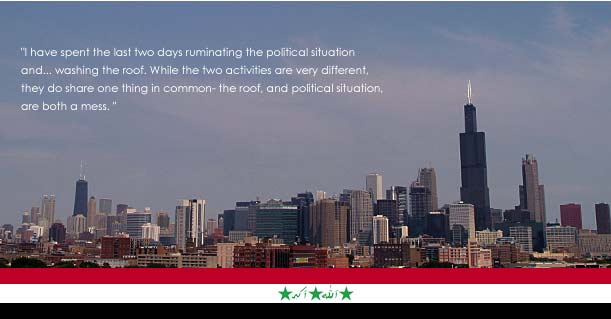
Iraq is a different place indeed. Our fear of being kidnapped in Chicago is second to the city suddenly switching to a republican stronghold – unrealistic. The only things that shut down roads in Chicago are construction and block parties, not tanks. We don't have patrolmen with automatic riffles; we have meter maids. We move around the city with a sense of freedom and safety. But, clearly, the differences between our cities are not based on reflections of what Baghdad is, but what it has become.
There are areas of our cultures that overlap, even in our own backyard. One of the best parts of Chicago is the freedom to escape your roommates, or the heat, or the stale smell of beer at a party and go out onto the porch. Porches are Chicago and we use them for everything from relaxing and partying, to drying our clothes. To be honest, it sounds like Iraq .
“During this last year, a certain sort of special bond has formed between your typical Iraqi and the roof of his or her home. We run out to the roof to see where the smoke is coming from after an explosion; we gather on the roof to watch the helicopters flying over head; we reluctantly drag ourselves out to the roof to fill the water tanks when the water is low; we hang clothes to dry on the clotheslines strung out haphazardly across the roof; we sleep on the roof during the endless, powerless nights
“On one of those powerless and sleepless nights I decided I would ‘feel my way up the stairs and out onto the roof. A few moments later, my younger brother E. joined me, disheveled, disgruntled and half-asleep. We stood leaning on the low wall enclosing the roof watching the street below. I could see the tip of Abu Maan's cigarette glowing in the yard next door. I pointed to it with the words,
“Abu Maan can't sleep either…”
“E. grunted with the words, “It's probably Maan[his son]”. I stood staring at him like he was half-wild- or maybe talking in his sleep. Maan is only 13… how is he smoking? How can he be smoking?
“He's only 13.” I stated.
“Is anyone only 13 anymore?” he asked.
“I mulled the reality of this remark over. No, no one is 13 anymore. No one is 25 anymore… everyone is 85 and I think I might be 105. I was too tired to speak and, in spite of his open eyes, I suspected E. was asleep. The silence was shattered a few moments later by the sound of bullets in the distance. It was just loud enough to get your attention, but too far away to be the source of any real anxiety. I tried to determine where they were coming from.
As Riverbend watches from her rooftop and we watch from our televisions, the tumultuous creation of a sovereign Iraq is unfolding. If Iraq is to operate as a democratic nation, the crux of democracy is its people. Just as we are not defined by the actions of the American government, Iraqis cannot be defined by what we see on television. To understand America is to understand the stories of its people; to begin to understand Iraq it is important to realize that its people are telling stories. Riverbend's story is purely an illustration of the personal narratives we cannot ignore in the current dialogue and debate surrounding Iraq .
It's not about who won the 2000 Presidential election, or our feelings about Fahrenheit 9/11, or our opinions on the newly sovereign Iraq . It is about understanding that we do not know the whole story and that our media is not going to give it to us. It's about not coming to a conclusion before you have both sides of a story. The ability to identify with life in the city of Baghdad provides the necessary tools to begin to comment on the situation.
Because, who are we?
“We the people”, the instigators of the new Iraqi government, should be able to recognize that people are the foundation of government, just as our founding documents guarantee.
Baghdad is a city with its own history and culture and it will use those factors to rebuild itself; we should try to understand that the steps toward building a new Baghdad cannot be separated from considering the people who live there.
|