| |
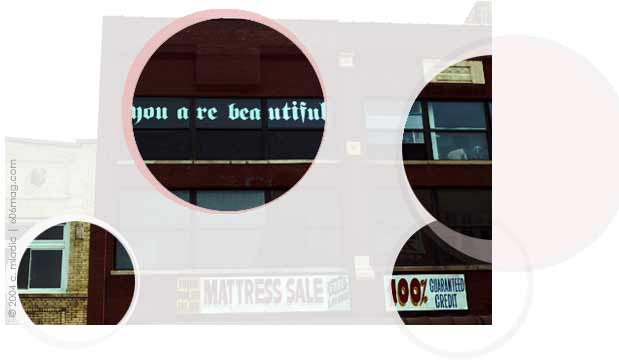
We have been conditioned to expect ads occupying such spaces, so the result of viewing an installation unknowingly can be quite unsettling. When we see an advertisement for chips, we are told that that we've been collectively brainwashed to say, “Hmm, I'm hungry for chips,” or perhaps more appropriately with the aesthetic of today's ads, “I'm going to eat these chips even if I'm not hungry because I'm so engaged with the wit of the chips' tagline/ the lifestyle of the models eating the chips/ the ass in the underwear of the model eating the chips”. When we see a billboard that says, “You are beautiful”, we can then suppose our uniform consumers thoughts go something like this: “That's right, I am beautiful….wait a second, what the hell does that mean? Advertisements tell me constantly that I am not beautiful enough. Could they be lying? Is it possible that I'm subject to a capitalist-driven aesthetic that I wasn't even aware of? I am going to stop wearing make-up.” Or we think we are hallucinating. Or we think we've witnessed a miracle, and start looking for the veil or the Virgin Mary in the shadow beneath the billboard.
This type of impulse provides room for split-second epiphanies. By disguising their message in the vehicle of capitalist persuasion, the “You are beautiful” crew allows each viewer to disassemble the message themselves. It's not the kind of art that beats you over the head with it's point. According to the artists, “It all comes down to intention. Nothing is sacred. Everything that has a perceived value becomes commoditized… Advertising elicits a response to buy, where this project elicits a response to do something. The attempt with You Are Beautiful is to create activism instead of consumerism.” Gone is the ego of advertisement (and a lot of art too). In fact, the artists wish to remain anonymous. They blur their faces on the website. They do not list their names.
My car takes a quick right off of Western.
“Where are we going?” I demand.
Kent Jockington laughs maniacally, and shouts, “I'm hungry for chips!”
That's when I see it in the distance. Red bulls-eye in the air, cars surrounds it, circling the lot like vultures.
Target.
“No, Kent, no!” I scream, “We can get chips somewhere else!”
“Hahahahaha! There is nowhere else!” says Kent Jockington.
Maybe you've never been to Target on a weekend in the middle of the day. You would think it would be a time that everyone was out to lunch, you would assume everyone to be tucked away in a restaurant calmly eating won-ton soup or egg rolls and drinking green tea.
Everyone goes to Target on Sunday afternoon. I've witnessed frequent accidents in the parking lot between patrons vying for the closest spot.
“It doesn't have to be like this,” I say. “There is more to selecting potato chips then pawning off a capitalist enterprises' lousy justification for free market exchange as your own.”
But Kent Jockington is possessed. His eyes mutate into tiny pulsating red bulls-eye logos.
Living in an egomaniacal landscape, in which every experience within a public space is filtered through textual noise, we expect affirmation. Public space is chock full of information that aims to affirm our existing ideals, so that we will identify with a lifestyle we crave to buy. If contemporary public art merely confirms societal norms, it creates more information to swallow, without offering a critic. Without this awareness, artists give a city public art for the sake of creating public art, art that may as well be created within a vacuum, though it does in fact occupy prime space in the public eye. Or worse, as was the case with Chicago's “Cows On Parade”, art that feeds in to the noise of capitalist spectacle.
Christopher Silva is a Chicago artist that works primarily in the public sphere, with works ranging from public funded murals to illegal graffiti. When asked how he negotiates between his roles as a paid artist and a spray paint recluse, he claims, “ My ideas of how I'd like to utilize public space are definitely not confined to what is legal and more often than not lean in the direction of what is not. It's just that I also have to make a living and I've decided to do it in the realm of art” .
While it's possible for an artist working in public space to suspend between roles, the tension between those competing for public space is evident even in the “cooperation” between sponsor and artist. Silva's current work includes a collaborative show that opened in May at Defiance Gallery. It consists of found object installations, many of which were redistributed on the street after the show. After a short tirade of possible faults with the product of the company that sponsored his show, Silva states, “I should still thank them for helping to promote our show. Thank you, you manipulative corporate fat cats.” It's hard not to look a gift horse in the mouth when you and the horse are competing for possession of high-traffic areas in the city landscape.
Circling the Target parking lot, arguing with an imaginary orthodontist, I am reminded of the first time I noticed how profoundly public tools of persuasion infiltrate everyday life. Back then, all my imaginary friends were dogs, because I had no credit card bills to fantasize about paying off and thus had no reason to create a friend with a steady income like Kent Jockington. In the second grade, there was an assembly; we all gathered in a grammar school basement to hear a guest speaker, who talked to kids about “The Power of the Media”. The idea was to prove how much T.V. our generation watched, how we should work on our imaginations instead. The first thing the speaker did was grab the microphone and say, “Finish this thought for me.” He paused gripped the mike and sang out, “Five, eight, eight….”
He held the microphone out to his grammar school audience.
We sang collectively back, “…two, three-hundred, EMPIRE!”
I was absolutely stunned.
Every kid around me had memorized the Empire Carpet Song. In all my seven years, I had never thought something like this possible. We looked around at each other and giggled like zombies.
This is scary. Not as scary as the fact that the very same public media tools can, say, convince a person to actually install a type of carpet, or vote for a political candidate, or support a war, but it serves as evidence of how thoroughly such tools infiltrate our collective consciousness. As long as public art exists in a space in which there are voices privileged to speak over others, it should not exist without addressing such social concerns inherently in its form, if not overtly in its message. As art imitates solicitation and solicitation imitates art, it becomes increasingly difficult to unpack any information in the public sphere at face value. The demand of finding new tools with which to read our surroundings is part of the challenge in confronting successful public art. The challenge is what distinguishes it from a landscape that otherwise only reaffirms what is comfortable to see and say in public space.
Kent Jockington thinks he sees a space opening up two rows over. He wants to know if I can get out of the car and stand in the space, to make sure no one else gets to it first while he turns the car around. I protest. I tell him it isn't fair. There's a little Toyota that's been looking for a spot right by the space in question. He tells me to do it anyway, what's the big deal? He tells me if I do it when we get inside Target, he'll buy me those overnight teeth whitening strips I've had my eye on. It's true, I really want those overnight teeth-whitening strips. An empty cab is approaching in my side mirror, closer than it appears. I place my hand on the handle of the passenger door and consider my options.
|


|