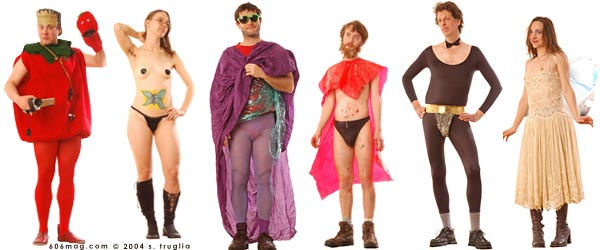
I wobbled across the room to find space to make sense of the chaos, trying to steer clear of stray body parts and dancing produce. The informative tables, the inclusive band, the protests against modified food — I may have stopped eating meat, but maybe that wasn't enough. I swiveled my head and straightened my back, a call for attention to my day to day habits. What had I been doing, going to Jewel and filling my basket with Preferred Card specials, allowing corporate pricing to dictate my food purchasing decisions? Buying organic was a way for me to take charge of my life, to influence the ebb and flow of the food market and international trade. Why should I support the injection of toxic chemicals into food that I put into my body? Why should I buy products that are clearly hazardous to my health and to the environment? I took a cleansing breath and decided to turn a new leaf in my life, a meaningful, green, organically grown leaf. I only needed a glass of organic beer to toast in my new lifestyle and solidify my stance.
With my new found hope for the future, I pulled out a dollar for a beer and thrust it proudly across the drink table.
They passed me a cold can of Pabst Blue Ribbon.
Organic farms have higher standards than non-organic farms . Non-natural pesticides and fertilizers are not used on organic food, making organic food free from toxins that might be found on non-organic food. By choosing all organic food I can improve my health, but I can also make a serious impact on the future of the environment, as organic codes are more ecologically friendly. While organic foods used to be sold only by specific grocers, they are much more accessible now. Walking down the aisle at most supermarkets, I can find organic products cuddling up right next to their non-organic counterparts. My decision rests within a six-inch span: save the environment and my health or support hazardous chemicals.
I had tried making organic choices before. I switched from plain pasta noodles to organic whole wheat pasta noodles, from baby spinach to organic baby spinach. My cabinets became their own ad campaign, scowling disdainfully at my roommate's environmentally destructive choices. Organic broccoli, organic bread, organic sugar came into my apartment in reusable canvas grocery bags. I brushed my teeth with all natural paste, and rolled my underarms with all natural deodorant. As part of a macroscopic plan, my microscopic decisions seemed to make ripples. I began to feel connected, active, responsible.
Sipping on an organic soy latte, I scooted into my desk and clicked onto Internet-based international news. The warm latte coated my throat, a perfect blend of subtle vanilla and creamy espresso. Out of curiosity, I began to trace our country's imports and exports, noting enviously that my food travels more than I do. Bananas from the Dominican Republic. Coffee from Kenya. Soy from Brazil.
I sunk beneath a wave of guilt, not unlike that leftover from Catholic grade school.
Soy from Brazil.
Brazil : in response to the growing demand for soy around the world, the Amazon rainforest suffers from a massive increase in deforestation as Brazil clears land for soybean farms
I looked at my Organic Vanilla Soy Latte, for which another section of Brazilian rainforest had perished. The problem with having forward set eyes, as all humans do, is that I can't see in more than one direction at once. While I was focusing on milk choice in the line at the coffee shop, my decision fed into a much larger problem that I had no idea existed.
Maybe the spinach I bought came from a farm that overworked its migrant workers, or maybe it used farm equipment that had not been checked for safety in 30 years. Maybe the toothpaste I used had been transported by the distributor in a vehicle that had been filled at a Shell station, who is responsible for enormous oil spills in Nigeria. Maybe the package from the whole-wheat pasta I have will be ignored by the recycling plant and buried into the nearest landfill where it will create toxic fumes.
Sipping on my decidedly non-organic PBR, I circled the gallery like a shark, slowly and deliberately, asking partygoers their reasons for costuming.
“THONG—I can't remember exactly what it stands for, but it's an organization that's been around for awhile trying to spread the word and educate people about what's out there for you organically. I'm just here supporting the cause and supporting the education.”
“Some people would just call this a silly expression of rebellion. I think that what's happening visually is actually a very poignant expression of a different point of view, and a different vision, where people are individuals, and people have freedom to make decisions, people are also free to know, and to be informed, to make decisions about what type of media, what type of food they want to consume.”
“I hope that this party will make people realize that it's ok to dress up funny, or dress up sexy, or interact with people on various levels.”
All attention moved to the corner of the room, where a performance was unfolding. A group of people wearing strips of white fabric passed a microphone among themselves, and a quickly paced call and response session flew from the speakers to the crowd. I stood amidst the screaming spectators, tiptoeing as if it were my height that was keeping me from understanding what was happening. A beige canvas tent with a single slit down the front began to shake, and suddenly a man began to tumble out of its mouth. Covered in an oozing white film, he rolled onto the floor, playing the part of an overgrown newborn. Several of the crowd took what appeared to be sugar and tossed it onto his placenta covered skin.
I turned inquisitively to the person standing next to me.
A middle aged man, proudly sporting a plain black cape and thong, sunglasses, and a hat, hunched forward to sip on his Busch Light. We were standing near the edge of the birth scene, which happened to be the loudest and smokiest part of the party. He seemed to be into the performance, and definitely into the theme.
“We are all kind of products of the food we eat—these are our bodies, this is what it looks like, and we can certainly be comfortable with that….it's just about body awareness,…an acceptance of what you are,” he said.
I sat back on my heels. While his interpretation seemed to have a certain amount of attractive idealism, there must be a point where this argument falls short. Two people might eat identical meals, but to assume that their bodies would process the food in exactly the same way is a gross oversimplification. We turned back to the performance. “Rooooon-ald. Reaaaaaaaagan.”
The movement of the hand from one's plate to one's mouth does not require steadfast concentration. This motion has been part of our daily routine for nearly all of our lives. Stopping our hands mid-arc, for reasons other than a loose hair or an intruding bug in our food, might be too ambitious a task for the empty-stomached. But the information behind the food we put into our bodies might give us ammunition against our consciences next time we choose broccoli that is twice as expensive as the next bunch.
I scanned the room, taking a last glance at the remnants of a good cause. It was two o'clock in the morning, and a giant carrot was swaying between a person in street clothes and a person in a thong. The food had run out hours ago, the cheap beer cans lay collected along the floorboards like the crushed, empty shells of dead insects. I pulled my cape tightly around my shoulders, the warmth of the room escaping with each drifting thonger.
Some people choose to eat all organic products to save the environment. Some people choose to eat vegetarian to save the animals. Perhaps they are well informed of the international food market, perhaps not. Personally, I do what makes sense in my head. The phrase “you are what you eat” might better be expanded to include that “you are what you choose to care about what you know about what you eat.”
<< back to page 1 |