 |
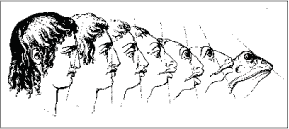
At the height of physiognomy's popularity, sketches were made by travelers and brought to the West to show all the people back home diagrammed pictures of the faces that were found: This is an Asian. This is an African. Illustrations of animals often accompanied these pictures to see how certain racial groups shared physical traits of animals and could therefore be expected to behave like animals: This is a Boar. This is a Rat. Physiognomy proved very useful in this country when the practice of slavery was called into question, as it made the convenient comparison between African-Americans and animals. This science was also a favorite of the Nazis who, while rounding up Jews to murder, made careful notes of the quintessential Jewish face, which were later used for propaganda posters to raise social awareness of the race's destructive behavior. |
Physiognomy has lost relevance in contemporary politics as differences between races have been unanimously agreed upon as unimportant. Soon, when we all will have genetically altered our faces, we can share one ideal set of features so it will be a lot easier to remember not to make any racial slurs , or not to call anyone “ugly.” When we all have the same pair of eyes to gaze into, they will obviously be the windows to our same souls too, so our collective morality will be top-notch. It will cease to matter that this country provides for freedom of religion, as we will have entered a state of moral utopia where there is no room or reason for dissent.
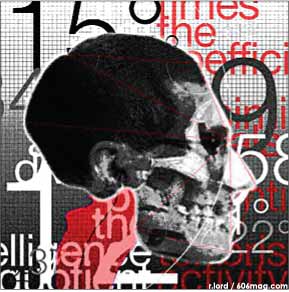
Beginning January 2004, foreign travelers to the United States have been required by law to undergo screening in all international airports and seaports before entering the country. Photographs and fingerprints are collected and stored in a database that catalogs information on all foreigners in the country at any given time. As passengers' photographs appear on screen, their image is compared to stored images of alleged terrorists and potential U.S. threats. Should a photograph resemble one of those alleged threats, the passenger is detained and pulled aside to be interrogated before entering the country. Most passengers claim that the inconvenience lasts only 15 extra minutes. The photographs are extremely high quality, taken with $368 million digital equipment, while the stored pictures of alleged threats are grainy, sometimes outdated, passport or ID photos. Only 1 in every 750 passengers scanned produces a false positive reading. The face of every traveler is compared to stored eye sockets, nasal bridges and foreheads that have been predetermined as dangerous and threatening physical arrangements. Guests from 27 countries, mostly European, whose races would not produce a face of any stored dangerous features, are exempt from submitting to the new U.S. admissions process. Visitors from France or Italy and vacationers from the United Kingdom just don't have that look of trouble to them; visitors from Brazil apparently do.
To combat the profiling of visitors to the United States, Brazilian security officials have implemented a widely publicized program of photographing and fingerprinting only American visitors to the country. Americans are outraged, as it seems clear enough to us that not a single one of our melting pot full of physical attributes could create a threatening profile. The whole world knows that Americans are a fair and morally upright group of people, who would never act in their own self-interest. Douglas Skolnick, the New Jersey man who was recently subject to $17,000 of fines for sticking up his middle finger for his fingerprinting screening in a Sao Paulo airport, showed the world that Americans have a great sense of humor too!
After the event, he defended himself as an American, in case his action left any confusion over his ethnicity, when he said, “I'm an American citizen. I'm not a monkey.” Apparently monkeys, like Brazilians, Iranians, Puerto Ricans and Russians, have a natural predilection toward giving samples of their fingerprints to government officials. Monkeys must be terrorists too. American zoos might benefit from a screening process before new animals are allowed into preexisting cages.
|