issues
1 2 3 4 5 6
7 8 9 10 11 12


  The Politics of Public Space
 

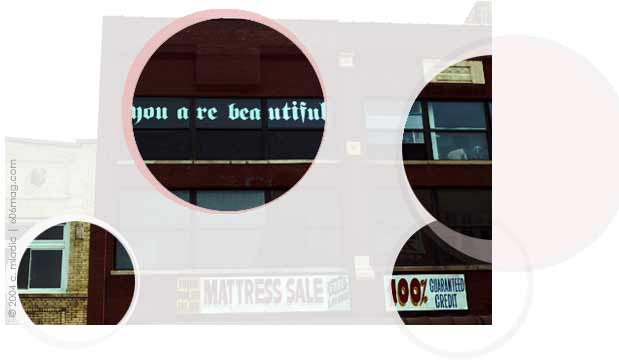
We have been conditioned to expect ads occupying such spaces, so the result of viewing an installation unknowingly can be quite unsettling. When we see an advertisement for chips, we are told that that we've been collectively brainwashed to say, “Hmm, I'm hungry for chips,” or perhaps more appropriately with the aesthetic of today's ads, “I'm going to eat these chips even if I'm not hungry because I'm so engaged with the wit of the chips' tagline/ the lifestyle of the models eating the chips/ the ass in the underwear of the model eating the chips”. When we see a billboard that says, “You are beautiful”, we can then suppose our uniform consumers thoughts go something like this: “That's right, I am beautiful….wait a second, what the hell does that mean? Advertisements tell me constantly that I am not beautiful enough. Could they be lying? Is it possible that I'm subject to a capitalist-driven aesthetic that I wasn't even aware of? I am going to stop wearing make-up.” Or we think we are hallucinating. Or we think we've witnessed a miracle, and start looking for the veil or the Virgin Mary in the shadow beneath the billboard.

This type of impulse provides room for split-second epiphanies. By disguising their message in the vehicle of capitalist persuasion, the “You are beautiful” crew allows each viewer to disassemble the message themselves. It's not the kind of art that beats you over the head with it's point. According to the artists, “It all comes down to intention. Nothing is sacred. Everything that has a perceived value becomes commoditized… Advertising elicits a response to buy, where this project elicits a response to do something. The attempt with You Are Beautiful is to create activism instead of consumerism.” Gone is the ego of advertisement (and a lot of art too). In fact, the artists wish to remain anonymous. They blur their faces on the website. They do not list their names.


My car takes a quick right off of Western.
“Where are we going?” I demand.
Kent Jockington laughs maniacally, and shouts, “I'm hungry for chips!”
That's when I see it in the distance. Red bulls-eye in the air, cars surrounds it, circling the lot like vultures.
Target.
“No, Kent, no!” I scream, “We can get chips somewhere else!”
“Hahahahaha! There is nowhere else!” says Kent Jockington.

Maybe you've never been to Target on a weekend in the middle of the day. You would think it would be a time that everyone was out to lunch, you would assume everyone to be tucked away in a restaurant calmly eating won-ton soup or egg rolls and drinking green tea.

Everyone goes to Target on Sunday afternoon. I've witnessed frequent accidents in the parking lot between patrons vying for the closest spot.

“It doesn't have to be like this,” I say. “There is more to selecting potato chips then pawning off a capitalist enterprises' lousy justification for free market exchange as your own.”

But Kent Jockington is possessed. His eyes mutate into tiny pulsating red bulls-eye logos.


Living in an egomaniacal landscape, in which every experience within a public space is filtered through textual noise, we expect affirmation. Public space is chock full of information that aims to affirm our existing ideals, so that we will identify with a lifestyle we crave to buy. If contemporary public art merely confirms societal norms, it creates more information to swallow, without offering a critic. Without this awareness, artists give a city public art for the sake of creating public art, art that may as well be created within a vacuum, though it does in fact occupy prime space in the public eye. Or worse, as was the case with Chicago's “Cows On Parade”, art that feeds in to the noise of capitalist spectacle.

Christopher Silva is a Chicago artist that works primarily in the public sphere, with works ranging from public funded murals to illegal graffiti. When asked how he negotiates between his roles as a paid artist and a spray paint recluse, he claims, “ My ideas of how I'd like to utilize public space are definitely not confined to what is legal and more often than not lean in the direction of what is not. It's just that I also have to make a living and I've decided to do it in the realm of art” .

While it's possible for an artist working in public space to suspend between roles, the tension between those competing for public space is evident even in the “cooperation” between sponsor and artist. Silva's current work includes a collaborative show that opened in May at Defiance Gallery. It consists of found object installations, many of which were redistributed on the street after the show. After a short tirade of possible faults with the product of the company that sponsored his show, Silva states, “I should still thank them for helping to promote our show. Thank you, you manipulative corporate fat cats.” It's hard not to look a gift horse in the mouth when you and the horse are competing for possession of high-traffic areas in the city landscape.

Circling the Target parking lot, arguing with an imaginary orthodontist, I am reminded of the first time I noticed how profoundly public tools of persuasion infiltrate everyday life. Back then, all my imaginary friends were dogs, because I had no credit card bills to fantasize about paying off and thus had no reason to create a friend with a steady income like Kent Jockington. In the second grade, there was an assembly; we all gathered in a grammar school basement to hear a guest speaker, who talked to kids about “The Power of the Media”. The idea was to prove how much T.V. our generation watched, how we should work on our imaginations instead. The first thing the speaker did was grab the microphone and say, “Finish this thought for me.” He paused gripped the mike and sang out, “Five, eight, eight….”

He held the microphone out to his grammar school audience.

We sang collectively back, “…two, three-hundred, EMPIRE!”

I was absolutely stunned.

Every kid around me had memorized the Empire Carpet Song. In all my seven years, I had never thought something like this possible. We looked around at each other and giggled like zombies.

This is scary. Not as scary as the fact that the very same public media tools can, say, convince a person to actually install a type of carpet, or vote for a political candidate, or support a war, but it serves as evidence of how thoroughly such tools infiltrate our collective consciousness. As long as public art exists in a space in which there are voices privileged to speak over others, it should not exist without addressing such social concerns inherently in its form, if not overtly in its message. As art imitates solicitation and solicitation imitates art, it becomes increasingly difficult to unpack any information in the public sphere at face value. The demand of finding new tools with which to read our surroundings is part of the challenge in confronting successful public art. The challenge is what distinguishes it from a landscape that otherwise only reaffirms what is comfortable to see and say in public space.


Kent Jockington thinks he sees a space opening up two rows over. He wants to know if I can get out of the car and stand in the space, to make sure no one else gets to it first while he turns the car around. I protest. I tell him it isn't fair. There's a little Toyota that's been looking for a spot right by the space in question. He tells me to do it anyway, what's the big deal? He tells me if I do it when we get inside Target, he'll buy me those overnight teeth whitening strips I've had my eye on. It's true, I really want those overnight teeth-whitening strips. An empty cab is approaching in my side mirror, closer than it appears. I place my hand on the handle of the passenger door and consider my options.

return to page 2    


The Politics of Public Space


comments: feature - the politics of public space
subject: *
date: 06.02.2004
name: *
comment:
you are beautiful
 
subject: **
date: 06.02.2004
name: **
comment:
and so are you
 
subject: White brites
date: 06.03.2004
name: Stephany
comment:
White teeth will only get you in trouble
 
subject: Stick to brushing
date: 06.03.2004
name: Phil
comment:
This ad thing has been something that I too have thought about. The more they pump it to you, the more you remember it. My 8th grade teacher did the same thing. Constantly repeating everything, drilling it into your head. It worked. Oh and those Whitening strips... they don't work that well, plus toothpaste is flavored.
 
subject: graffiti
date: 06.09.2004
name: mike
comment:
Graffiti also has roots in gang-tagging, which, in itself, is critically demonstrative and dangerously competitive. Sound familiar? How many of these signs go unnoticed? We should be careful not to tune out those far-reaching and more relevant signs of urban decay/sprawl or even growth. It's good to remember that the public space continues to be co-opted by the most powerful groups in any given area, whether they be corporations, gangs, or cityscape artists.
...good article sarah!
 
subject: banging
date: 06.15.2004
name: neo
comment:
any1 up for it?
Reply
[email removed]
 
subject: unsatisfied
date: 06.15.2004
name: johnny come lately
comment:
Wow, way to take three of the most hackneyed “I’m rebellious” subjects and roll them into one ridiculous article. I feel like I just read 3 half finished stories from a college newspaper that were thrown together at the last minute and transitioned between with pretentious “sound bite” worthy paragraphs. I’m glad to see that you are sticking true to the theme of this month’s sixosix by recycling such stale themes as, “Graffiti: public art or public enemy,” “Advertising & why the Man is bad,” and “Cute and clever idiosyncrasies from my pathetic personal life.” Sorry, I guess I’m just frustrated because up until this point sixosix has provided some solid lunch hour reading—now I just have to go back to work with a headache from this article’s recurrent misuse of “its” and “it’s.”

 
subject: johnny come
date: 06.15.2004
name: lately
comment:
thank god some one said it. I agree. Very unsatisfied.
 
subject: Johnny come lately
date: 06.15.2004
name: lsmft
comment:
Nice to know that Johnny can spend an entire lunch hour down off the mountain to explain to all of us what is and isn’t cool. Thank god for guys like him, otherwise the rest of us wouldn’t have any standard for measuring dickheads.
 
subject: Johnny
date: 06.16.2004
name: Jenny
comment:
I don't think Johnny was trying to tell us all if this was cool or not. I like the way the article was presented, but I have to agree, i've seen this subject matter written about before so it wasn't anything new.
 
subject: Nothing new but.....
date: 06.16.2004
name: chicago
comment:
The presentation is nice, but agreed, a usual topic. The chicago center though is kinda nice.
 
subject: Presentation and topic
date: 06.16.2004
name: lsmft
comment:
I think because of Johnny we’re losing sight what the piece is actually about. We all know that “the man is bad” and that graffiti art has this odd duel nature where it can cheapen or beautify. These things are given, but they are also usually left to the realm of theory, and it’s rare for us to open our eyes and actually look around at what the constant bombardment of text we experience is actually saying. Though the subject may be a little hackneyed it is also one that morphs and changes constantly making it absolutely necessary to take stock every once in a while.
 
subject: here's johnny
date: 06.16.2004
name: marco
comment:
Yeah, public art is such a hackenyed discussion. Same with world hunger. Such an overdone, usual topic. Every time anyone brings up all the starving people in the world, I think, "Jesus, what's the point of bringing up something so trite! Why would I care about people starving locally, when I already read about this kind of thing in a newspaper when I was in college!"
 
subject: Johnny's Back
date: 06.17.2004
name: Johnny come lately
comment:
lmfst: I agree, my comments did lose sense of what the article was about. But I think the article itself lost sense of what it was really about. While I thought the “main idea” actually could have been interesting, truthfully that main idea was like the string that holds together the patches of a quilt: you know it is there and serving a purpose, but the flamboyant patches of recycled material entirely distract from importance of the string.
Marco: Compliments on your use of a slippery slope-esque argument. But while we’re on the topic, why aren’t we talking about world hunger? When I started reading this article, I was looking forward to a conversation about “the politics of public space” that are a little more presently poignant—the “pissed off voter” stickers (the one’s with the statue of liberty holding a baseball bat), the “George W. Bush is a punk ass chump,” stickers, the scrawling of “fuck war,” I’ve seen everywhere recently, the protesters in front of the Chinese embassy. Back in the “Clintonian” era, I enjoyed several similar articles on graffiti in Chicago. But that was then, now I am not afforded the luxury of musing about ‘what graffiti is,’ ‘the constant bombardment of text we experience,’ or ‘art for the sake of art,’ because I am thinking about war, torture, and the possibility that my friends, family, or I could be drafted. It has already been established what graffiti is, you added an element of “where” by using Chicago—please tell me why I care in the current context: for example, is graffiti making an anti war stance? Yes, you could revisit the topic of graffiti as it changes or morphs, but besides the PR bit about the Defiance Gallery, what is new?
I just wanted to say to Sarah and all of 606 you should be very happy right now. Look at the conversation you have sparked. Sarah, I’m sorry it had to start with me bashing your article, but you’ve done much better work, and as a reader of your work I felt it was my duty to tell you this wasn’t as good. I like this magazine, I want it to flourish, and as such, I will not be some “yes man” who just praises everything that 606 craps out nor will I just leave posts trying to solicit a “bang.” I, your reader, am here to challenge you and hunger for more of what I think you can provide me. If you are offended by my opinions, I think you are missing the point—people are thoughtfully reading your articles.
 
subject: Johnny
date: 06.17.2004
name: 606
comment:
You're right...pretty happy over here
 
subject: this is your author speaking
date: 06.17.2004
name: sarah
comment:
johnny: Since I've been directly addressed, I think it's fair to make a few comments. I'm ecstatic with the discussion that's on the board. That's clearly the point of having in up here in the first place, so it's ideal to have an actual discussion instead of using this as a place for one-line compliments and petty observations. So you, dear reader, have a discerning eye that won't let us get away with sub-par articles. Don't apologize. I'm surprised we haven't started more fights up here, sooner. Amendable. Your idea for an article on the use of public space as it responds to the war is a good one. It, however, was not the topic of this piece, and so beginning a discussion founded on why this piece doesn’t match your idea for a piece on public art is awfully one-sided and dull, you must admit. You should know that this piece was originally written to be included with the May issue, under the monthly topic of "Architecture". All May articles deal in some way with space, Chicago buildings, if not architecture itself. It would have been a better context for the article, I think. In thinking about architecture, I set out to look at public space as a constructed space (because, of course, it is), and wanted to use it as a chance to cover a few local artists whose work directly confronts in topic, if not by mere placement, the use of public space. This is not meant to be a damn-the-man-and-fuck-advertising rant, but rather a note of how the two (ads and art) mimic each other consistently around your city. This is obviously not a new idea, but rather one with quite a history of discussion. The “pathetic”, “idiosyncratic” conversations that punctuate the article, certainly do not represent this writer’s stance, but are meant to parody, through sheer absurdity, the routine rants on the topic, as both a device to play out two sides of the debate, and to provide a bit of comic tension in an otherwise often (in my opinion) long-winded exposition. If this did not come across, these are good things for a writer to know. So don't put away your red pen.
 
subject: yeah
date: 01.11.2005
name: RHEEKISM
comment:
RHEEKO ONE OMN CREW IN THIS BITCH
 
subject: Damn it Rikoh
date: 04.28.2005
name: ikonoklast
comment:
Way to make graff artists look stupid.
Anyway, it never ceases to amaze me how ignorant and shortsighted people can be, especially about activities they obviously know next to nothing about or have never experienced. Graffiti doesn't have roots in gang graffiti at all, they're two disparate activities. The first credited "graffiti writer" as we know them was Cornbread, and he was no gangbanger, but merely went around putting his name everywhere to get the attention of a girl. This type of thing eventually developed into hiphop graffiti which was concerned with beautifying the horrid urban conditions AND becoming famous as a result in a small community of other graffiti writers (the latter has become of the utmost importance in the modern era).
The work of You Are Beautiful, Chris Silva, Juan Angel Chavez, Miko Genovese, and Cody Hudson is distinct from tradtitional graffiti (tags, throw-ups, pieces, etc) because of its intention and way of dealing with space. These artists are not converned with rising in an invisible hierarchy (like traditional graffiti writers such as Rheeks above) but with using the public domain as a means to exchange or provoke thought THROUGH their work.

"As long as public art exists in a space in which there are voices privileged to speak over others, it should not exist without addressing such social concerns inherently in its form, if not overtly in its message"
The fact is with YouAreBeautiful, they are encouraging everyone to take a positive role in the improvement of society, even with the small positive reinforcement statement of You Are Beautiful. Street artists are not shouting over the people, they are giving examples to the people as if to say " We all can make a change, here's the way I do." The medium is not purely the message as we see YAB and traditional graffiti writers may use the same mediums of stickers to get their point across. The message must however correspond. If you are trying to free others from slavery, you don't free them and then make them your slaves. Traditional graffiti writers tend to have a slave mentality or a hive mind that comes from the strict aesthetic rules that must be obeyed lest one be outcasted from the community. The art doesn't speak to anyone anymore, it's stagnant. It's speaking in a language that only the artists can understand, it's become so stylized and overblown that it's meaningless. The transition from traditional tags and throw-ups to installations seems thematically akin to the transition from aristocratic portraits to impressionistic or modernist paintings.
 
subject: this is one of those topics...
date: 04.29.2005
name: Drdick
comment:
That the average citizen will never understand like media monopoly or consumption society - but it is good to get it out. www.flowfeel.com
 
subject: Damn IT REEKS!!!
date: 10.28.2005
name: lie59
comment:
I believe the use of graffiti is as diverse as the people using it as a way to communicate. As simple a statement as that is; it's true. Reeks is young and just wants to get up like crazy, it's probably his only way to vent his frustrations. He's a visual thinker and it's his only way to communicate. If he was a bit more articulate he'd probably say that he supports the Graf movement and that he's proud to be a member of his crew. DEBATE from the OMN/UHF crew is a bit more mature and uses graffiti as a way to make people think, I have no doubt that he will push the graf art form to a newer level in Chicago. Likewise, REST, also from the OMN crew, is a pure artist, and everything he does is visually stunning. Much love to the OMN Crew and all the Chi-Town Graf artists. Respect to all!
peace,
lie59