At first glance it seems like a pretty obvious narrative chain: Two of Danielewski's creations interact through the text of House of Leaves, competing for the page. But that's too simple an explanation, so how about Danielewski creates Truant who in turn creates Zampanò and “The Navidson Record”? How about Zampanò creates “The Navidson Record” and Truant? Hell, maybe Will Navidson wrote a critical response to his own film, inventing our narrators and distorting reality in much the same way his former residence did. And while we're dealing with it, where does Danielewski fit in? Who created him?
Part of the novel's appeal is that it can be read as a straightforward set of narratives, but if you peek just bellow the surface it falls like a house of cards (or of leaves). Don't even get me started on the ways this telescopes out of the book, calling into question this boundary between book-real and really-real.
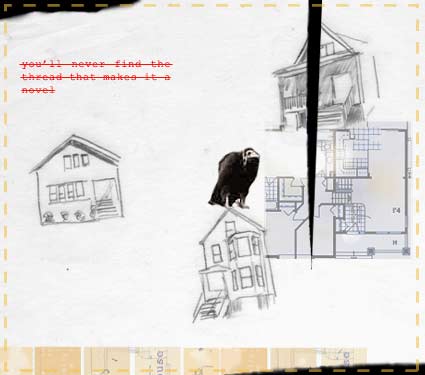 Ok, do get me started. Ok, do get me started.
Typing in “ House of Leaves ” to Google will get you a whole world of trouble . The novel's publication history is easily accessed, and you find that House of Leaves was originally published on the Internet for Danielewski's friends and “just escaped.” It was picked up by Random House and published in five different designs: a limited hardbound full-color edition with a raised Braille epigraph for chapter 20, a hardbound edition with selected text in blue and red, a signed hardbound edition , a softbound edition with selected text in blue or red and a no-color softbound with missing pages.
Beyond that things get a bit problematic, as this is where the some of the blending of realities starts. Look as hard as you want, you'll never find any evidence that House of Leaves was published on the Internet. You might find someone who claims to have read the book in it's early form, but let's face it – he could be making claims on a House of Leaves message board with one hand and pretending to be a 14-year-old girl in a chat room with the other. No one can even explain what format the supposed Internet publication was in, whether it was a collection of Web pages, full of nonlinear links to other sections of the text, or a simple Word document, unencumbered by the non-linear typesetting of the printed version.
And it gets better. Our intrepid editor, Johnny Truant, has an experience similar to that of Danielewski when he finds the manuscript has escaped into the ether of the Internet. Truant's House of Leaves is distributed by Circle Round a Stone Publications, a company that doesn't exist in our world, yet fan sites will claim that Circle Round a Stone distributed Danielewski's manuscript as well. Just by suggesting that the novel has a history similar to the manuscript within the novel, Danielewski creates something for us to unravel. Just to make things worse the publishers serialized the novel at a site called iuniverse.com just before the release of the book , but this is hardly consistent with the so-called facts.
Not only did the manuscript potentially never exist in its e-published “first edition” form, but not all of the editions listed in the publisher's block exist either. What some fan sites describe as the limited-to-2000-copies-full-color hardbound wasn't purchased by any library, public or private, isn't available for an insane price on eBay and, most tellingly, doesn't have an ISBN . Other fan sites explain that the limited edition has yet to be published, which seems more likely, but doesn't change the fact that people talk about the full color edition as though it exists.
I've even come to believe that this muddling of the facts even extends to an intentional flaw in the book's binding. The softbound editions are prone to losing the first two pages after a little bit of wear. Even when these pages are attached to the binding, the author's name only appears as a possessive, “Mark Z. Danielewski's.” But if you were to buy the book used or borrow it from a friend and these pages were missing, what was left of the title page spread would read “House of Leaves by Zampanò Edited by Johnny Truant.”
You can't really draw any conclusions from all of this. As with the novel, you can't be sure if the information that surrounds it bares any resemblance to a “reality” and if it does you won't find where that resemblance lies. The origins of the novel are an echo of the novel, a distorted reflection that changes depending on where you look at it from.
Back when House of Leaves was first published, in a bound edition, purchased at a bookstore, in this reality, I had the opportunity to attend one of Danielewski's readings. I asked him if he had intended to suggest an Web page link by having the word “house” printed throughout the novel in blue, as it consistently is, and if so, what did this “unclickable” link imply? He said he hadn't thought about it, but that the implication worked for the novel. It is a reference with nothing to reference, since the link can't go anywhere. Again the novel, and by proxy the world in general, pulls the rug out from under us. Thus my small contribution to the ever-expanding thing that is the novel.
The novel is about a house that is bigger on the inside than it is on the outside. The novel itself is likewise unconstrained by our expectations, able to shift its shape and expand beyond its container. It's a neat trick, but it's also an important one. Like Truant, Zampanò and Navidson, we are encountering houses of leaves in our everyday lives. We watch reality television that has nothing to do with reality and use an information superhighway where the quality of said information is easily called in to doubt, regardless of the speed at which it arrives. We make the dangerous assumption that what we are seeing is real despite the fact that these media and many, many others have become detached from reality. Our language is changing, losing its meaning, its points of reference, being able to surf, chat, or interact without actual physical activity, words or visual reference is only the start. Our technology is altering the way we understand distance and location to a point where bringing us closer together can also mean that we won't know where we are. It's imperative we understand what House of Leaves is because we're closer than you might think to not understanding what a house is, much less the idea of a house of leaves. For that matter even the word novel is getting a bit fuzzy around the edges.
|




